Can Cyclogyro transform riverine Bangladesh’s travel experience?
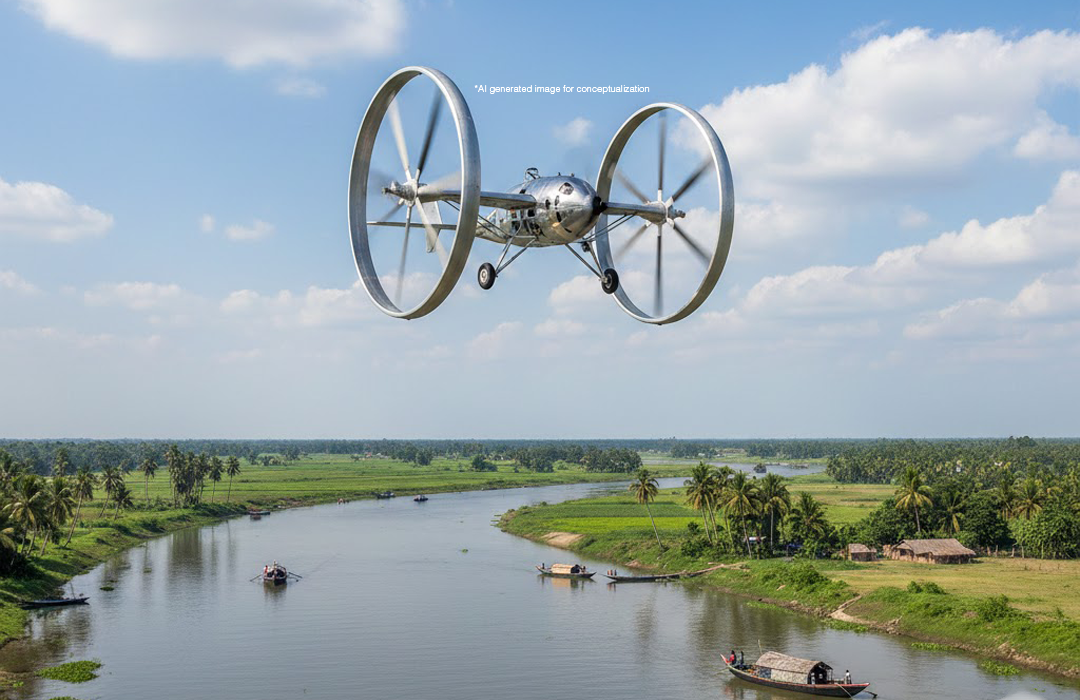
Conceptualization: Aviation Express
On a sweltering February morning in 2026, a launch from Sadarghat terminal crawled across the Buriganga, its engine coughing diesel fumes into the humid air. Inside, passengers sat shoulder-to-shoulder, waiting. Always waiting. The journey to Barisal would take eight hours, if the waters were calm, if the engine didn’t fail and if fate smiled upon them. Meanwhile, just twenty feet above the muddy current, a heron took flight, gliding effortlessly toward the horizon. The bird reached its destination in minutes. The passengers would not.
This is the paradox of riverine Bangladesh where a nation carved by 700 rivers, blessed with natural highways, yet cursed by the tyranny of time and tide. We are a nation intimately acquainted with water, such as the Padma's relentless currents, the Meghna's sprawling embrace, the countless tributaries that vein through our sediment-rich delta. Yet for all our rivers, we remain earthbound, at the mercy of ferry schedules, monsoon floods, and the agonizing crawl of launches that seem to mock the very concept of urgency.
But what if we didn’t have to choose between water and speed? What if there existed a machine that married the logic of our paddle-wheeled launches with the freedom of flight, a contraption so peculiar it sounds like something from a Jules Verne fever dream, yet so practical it might revolutionize how we navigate our waterlogged homeland?
Should we use the ‘Cyclogyro’? It is a flying machine that spins like a riverboat’s wheel but soars like a bird.
A wheel that refuses gravity
To understand the Cyclogyro, also called a Cyclocopter, imagine standing on the banks of the Padma, watching a paddle steamer churn past. Those great wheels slapping the water, driving the vessel forward. Now tilt that image ninety degrees, shrink it, make it spin horizontally like a barrel on its side, and replace the paddles with delicate, curved wings. What you have is a ‘Cyclorotor’, a cylindrical drum studded with airfoils that rotate around a horizontal axis, each clade shifting its angle, its ‘pitch’, as it spins, creating lift instead of propulsion through water.
It's aviation’s forgotten stepchild, born in an era when airplane designers were still trying to figure out which end went forward. While the Wright Brothers’ fixed-wing philosophy eventually conquered the skies and Igor Sikorsky's helicopters became the standard for vertical flight, the Cyclogyro languished in the margins of aeronautical history, too strange, too complicated, too prone to violent vibrations that rattled early test pilots’ teeth.
Yet here we are, nearly a century later, and this oddity is experiencing a renaissance. Thanks to advances in materials science, computer-controlled pitch mechanisms, and electric propulsion systems, what was once dismissed as an engineering curiosity is now being seriously reconsidered. Small drones using Cyclogyro principles have been successfully tested. Research papers proliferate. And for Bangladesh, a country where geography itself seems designed to frustrate conventional transportation, the timing couldn’t be more intriguing.
Why Bangladesh needs to look up?
Consider the monsoon of 2022. Across Sylhet and Sunamganj, the haor regions transformed into a vast inland sea. Roads vanished beneath murky water. Highways became rivers. The photographs were haunting: rooftops emerging from floods like the humps of drowning giants, people stranded on whatever high ground they could find, waiting for rescue boats that took hours, sometimes days, to arrive.
Or think of the Sundarbans, that magnificent tangle of mangroves and tidal channels where land and water engage in a perpetual argument over boundaries. Even today, reaching remote forest stations means navigating treacherous waterways where tigers swim and crocodiles lurk, where boats run aground on hidden mudflats and cyclone warnings can strand you for days.
And then there is Dhaka itself, gridlocked, gasping, growing upward because it can no longer grow outward. On a typical afternoon in Mirpur or Mohakhali, traffic doesn’t flow; it congeals. A journey of five kilometers can devour two hours of your life. The rich escape in helicopters, landing on hospital or hotel helipads. The rest of us simply suffer.
This is where the Cyclogyro's peculiar abilities become less theoretical and more tantalizing. Unlike conventional aircraft, which require long runways (a luxury Bangladesh’s dense development rarely affords), a Cyclogyro is a VTOL (vertical take-off and landing) machine. It needs no more ground space than a small parking lot. Unlike helicopters, whose spinning rotors make them dangerous in confined spaces and vulnerable to wind gusts, a Cyclogyro's enclosed, drum-like rotors are more compact and potentially more stable.
Imagine, a medical drone equipped with Cyclorotors, departing from Dhaka Medical College Hospital’s roof, carrying blood supplies or organs for transplant. It would skip over the traffic snarls of Elephant Road, bypass the bottleneck at Shahbagh, and land on the roof of a district hospital in Gazipur in less than an hour. Or picture disaster response after the next Sidr or Aila, Cyclogyro-equipped drones surveying flood damage, dropping relief supplies to isolated communities, evacuating the injured from areas no boat can reach.
The wheel turns through history
Cyclogyro’s story begins, appropriately enough, with dreamers and mavericks. In 1927, an American inventor named Jonathan Edward Caldwell secured U.S. Patent No. 1,640,645 for a ‘Cyclogyro propulsion system’, a design so audacious that the patent office must have wondered if he had been sampling moonshine. The idea was simple in concept, nightmarish in execution; instead of fixed wings or overhead rotors, why not mount wings on a spinning barrel and continuously adjust their angle to generate lift?
Three years later, the Schroeder S1 actually flew using Cyclogyro propulsion, though ‘flew’ might be generous; it more accurately ‘lurched into the air while making alarming noises’. In 1933, German engineer Adolf Rohrbach proposed a proper Cyclogyro aircraft with a tall fuselage keeping the rotating drums well above the ground. And in 1935, Rahn Aircraft in America built what might have been the technology's best pre-war attempt: a machine with two massive cyclorotors and a powerful engine.
It vibrated like a paint-mixer. Pilots reported that controlling it was like wrestling a mechanical bull. The project died quietly, and the Cyclogyro faded into obscurity as World War II accelerated development of conventional aircraft and helicopters.
Revival and reality
Why resurrect such a temperamental technology? Because the problems that defeated 1930s engineers, vibration, control complexity, power requirements, are exactly the sort of challenges modern technology excels at solving.
Computer-controlled pitch mechanisms can adjust each blade’s angle hundreds of times per second, smoothing out vibrations that once made Cyclogyros unflyable. Lightweight composite materials reduce weight while increasing strength. Electric motors provide precise, instantaneous power control. And perhaps most importantly, the rise of unmanned aerial vehicles, drones, means we no longer need to risk human pilots while perfecting the design.
Recent research by institutions like IEEE (the Institute of Electrical and Electronics Engineers) and the American Physical Society suggests that Cyclogyros may excel in precisely the environments where helicopters struggle; such as, confined spaces, gusty winds, hovering maneuvers. The Cyclorotor's ability to direct thrust in any direction, up, down, forward, backward, sideways, without tilting the entire aircraft makes it potentially more agile and stable than conventional VTOL designs.
For Bangladesh, this matters. Our weather is not polite. Cyclones roar in from the Bay of Bengal with terrifying regularity. Monsoon winds gust unpredictably. A flying machine that can handle turbulence and maintain precise control might be the difference between successful disaster response and a failed mission.
The dream and the distance
But let’s be clear-eyed. The Cyclogyro is not coming to Sadarghat terminal next Saturday. Significant obstacles remain.
Cost
Current prototypes are research projects, funded by universities and aerospace companies. A viable commercial Cyclogyro, whether cargo drone or passenger craft, would require massive investment. Bangladesh’s aviation sector is still grappling with maintaining conventional aircraft; adding an entirely new category of flying machine would demand resources we may not possess.
Regulation
Civil Aviation Authority of Bangladesh (CAAB) already struggles to regulate the growing drone industry. Cyclogyros would introduce new regulatory headaches; such as flight corridors over rivers, noise standards, safety certification, pilot training (or remote operator training). We haven’t even sorted out proper rules for delivery drones; Cyclogyros would be exponentially more complex.
Weather
Yes, Cyclogyros might handle wind better than helicopters in theory. But Bangladeshi cyclones are not theoretical. They are concrete, catastrophic reality. Any flying machine operating in our skies must survive not just normal monsoon weather but the occasional meteorological apocalypse.
Infrastructure
Where would these machines take off and land? Building helipads across Bangladesh’s cities and towns would require urban planning coordination that currently seems optimistic. And in rural areas, the very places most likely to benefit, power supply for recharging electric Cyclogyros remains erratic.
Grounded hope
Yet despite these challenges, the idea persists, tantalizing as a mirage on the Padma’s waters.
Because here is the truth, Bangladesh has always been a nation of impossible navigation. We are the country that shouldn’t exist, a delta that floods, a landmass that shifts, a place where rivers change course and swallow entire districts. We have adapted by building on water, floating schools and hospitals, growing gardens on rafts. We have made our peace with impermanence.
The Cyclogyro, in its peculiar way, fits our national character. It is a technology that refuses to accept conventional limitations. Can’t build runways? Fine, we will take off vertically. Can’t fly in tight spaces? Watch this barrel-shaped rotor hover between buildings. Need to reach a flooded village? We will skip the roads entirely.
For now, the most realistic application would be unmanned vehicles; such as cargo drones delivering medical supplies to haor regions, survey drones inspecting flood damage, agricultural drones servicing riverside farms. These would not require the regulatory nightmares of passenger flight, and the smaller scale would make prototyping more affordable.
A Bangladeshi university, BUET, perhaps, or a well-funded private institution, could realistically develop a working Cyclogyro drone within five years if resources were committed. International partnerships with aerospace research institutions could accelerate development. And once the technology proves itself in limited applications, scaling up becomes imaginable.
The spinning horizon
On that same February morning, while passengers on the Sadarghat launch settled in for their eight-hour journey to Barisal, somewhere in a laboratory far from Bangladesh, engineers were testing the latest cyclogyro prototype. It lifted smoothly, hovered perfectly, and darted sideways with insect-like agility. The heron that had crossed the Buriganga in minutes might soon have mechanical company.
Cyclogyro won’t solve all of Bangladesh’s transportation woes. It won’t unclog Dhaka's traffic or prevent monsoon floods. But it represents something valuable; proof that old ideas, combined with new technology, can offer fresh solutions to ancient problems. It reminds us that being a riverine nation doesn’t mean being earthbound, that the skies above the Padma and Meghna might yet become as navigable as the waters below.
For a country committed to people's right to know, to move, to access help when disaster strikes, that spinning wheel in the sky isn’t just an engineering curiosity. It’s a promise, distant but real; that one day, the journey from Sadarghat to Barisal might take not eight hours, but eight minutes.
And the heron might finally have company.

Make Comment
Login to CommentPopular News





Subscribe to News Letter
Latest News