RAF carries out 7,000-mile mission to deliver medical aid to remote South Atlantic island
 Desk Report
| Published: Tuesday, May 12, 2026
Desk Report
| Published: Tuesday, May 12, 2026
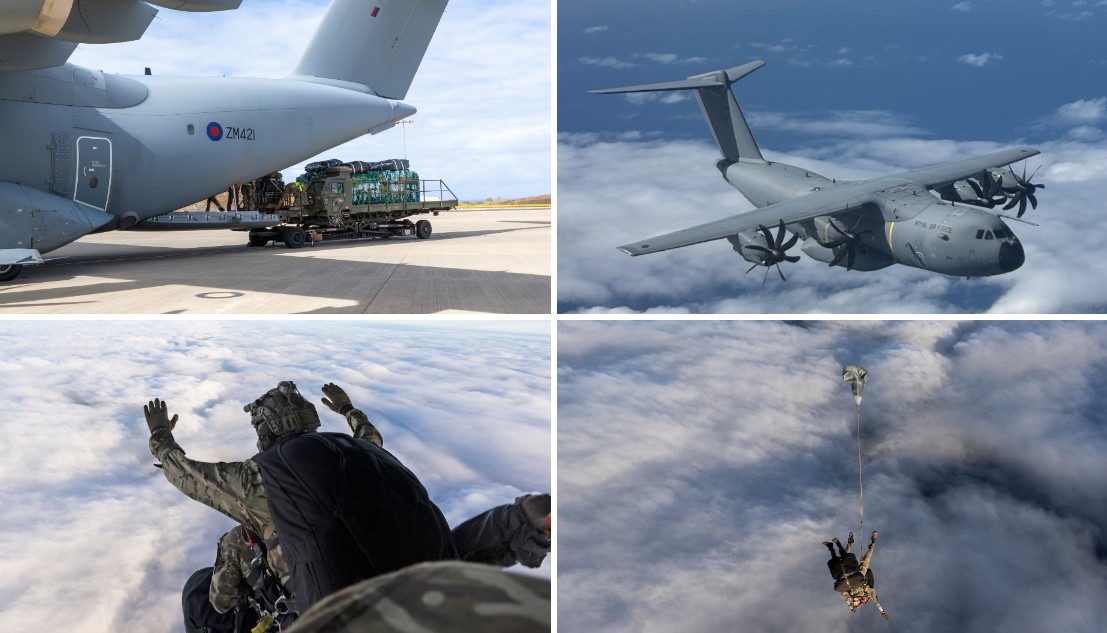
Photo: RAF
Britain’s Royal Air Force (RAF) has completed a long-range mission to deliver emergency medical assistance to residents and British nationals on the remote South Atlantic archipelago of Tristan da Cunha, using a precision parachute airdrop after the absence of an airfield ruled out a conventional landing.
The operation, conducted in support of a mission led by the UK Foreign, Commonwealth and Development Office (FCDO), involved the delivery of critical medical supplies alongside an RAF anaesthetist and a British Army nurse, according to an RAF statement.
Tristan da Cunha, a British Overseas Territory located in the South Atlantic Ocean, is widely regarded as the world’s most remote inhabited archipelago, lying more than 2,400 kilometres (1,500 miles) from the nearest inhabited land.
The mission involved an Airbus A400M military transport aircraft flying more than 7,000 nautical miles from the United Kingdom via Ascension Island, supported by air-to-air refuelling from an RAF Voyager tanker aircraft to sustain operations over the long distance.
“Providing air-to-air refuelling in support of the A400M was central to the mission,” Wing Commander Graham, an RAF Voyager spokesperson, said in a statement.
“It enabled the A400M to operate at range, remain overhead for the para and container aerial dispatch, and recover safely, demonstrating how tanker capability acts as a force multiplier for air operations,” he added.
With no operational runway available on the island for large aircraft, the RAF said medical personnel and aid were delivered through a precision parachute drop coordinated alongside Britain’s 16 Air Assault Brigade.
The operation required extensive planning and close coordination between aircrews due to the remote location and limited infrastructure, the RAF said.
“This was an exceptionally demanding mission, showcasing the very best of our crews, our Voyager Force colleagues, and the many enablers who make every sortie possible,” said Wing Commander Christopher, Officer Commanding 30 Squadron.
“The remote location of the airdrop demanded detailed planning and close coordination, with crews managing long distances and refuelling in flight to sustain the mission,” he added, saying the operation had delivered “lifesaving aid directly to those who needed it most."
The RAF said the mission was conducted alongside ongoing operations in multiple regions, including the High North, the Middle East, and the South Atlantic, underscoring Britain’s ability to maintain military readiness while supporting humanitarian and diplomatic efforts abroad.
Source: RAF

Make Comment
Login to CommentPopular News



Subscribe to News Letter
Latest News